
Categories
cdd highlight job

[Job] Post-Doc: C++/HPC – MLIR / JAX / Pytorch / Kokkos 👩‍💻🧑‍💻

🧭 Context

The European HPC landscape is transforming rapidly, with the emergence of Exascale systems such as the upcoming Alice Recoque supercomputer at CEA. These heterogeneous architectures require new programming paradigms to maintain performance and portability across varied GPU and CPU vendors. To address this challenge, the CExA “Moonshot” initiative contributes to key software infrastructure like Kokkos and leverages modern compiler frameworks such as MLIR (Multi-level Intermediate Representation) to establish a sustainable approach for domain experts to develop their applications without deep understanding of the modern programming models and architectures. For this purpose, we will explore the coupling technology of kokkos/python with MLIR to allow code developers to maintain kokkos codes only with the python expertise. As a case study, we will port a legacy fortran application for MDFT (Molecular Density Functional Theory) with modern programming approaches including Kokkos, Kokkos/python and python. Then, we will evaluate the performance portability, readability, productivity and mainatinability aspects of each approach to find a reasonable programming model to develop a code for domain scientists. This position is a 2 years posistion as part of CExA’s efforts to integrate advanced techniques, including JAX-based or PyTorch-based AI models, into our HPC workflows, fostering hybrid workloads that combine simulation and machine learning.

🎯 Mission

As a core member of the MDFT and CExA teams, your mission will be to develop, prototype, and evaluate tools and methodologies for performance optimization of MLIR-Kokkos-based HPC applications. A publication at highly competitive conferences such as Supercomputing is foreseen.

Your main responsibilities will include:
  • 🔧 Tooling Development
    • Introduce a Kokkos dialect in MLIR as an intermediate representation of Kokkos
    • Implement a translation inflastructure (based on potentially existing intermediate dialects) between Kokkos and JAX / PyTorch
  • 📈 Code Optimization
    • Profile and optimize MDFT across multiple architectures (Nvidia GPUs, AMD CPUs/GPUs, Intel CPUs)
    • Evaluate integration opportunities for AI-based models via JAX or PyTorch to support hybrid workflows
  • 🤝 Collaboration & Outreach
    • Collaborate with other CEA teams and international partners (Europe, US, Japan)
    • Present results in conferences, workshops, and open-source contributions

🧠 Skills

You are a passionate engineer with a background in scientific computing and a drive to push the boundaries of performance portability.

Must-have:
  • Experience with LLVM, or compiler infrastructure
  • Proficiency in modern C++ (17 or later)
Bonus:
  • Experience with performance optimization and profiling tools (e.g., VTune, Nsight)
  • Familiarity with Kokkos or other GPU portability frameworks
  • Familiarity with MLIR, or compiler infrastructure
  • Solid software engineering practice: git, cmake, CI/CD, unit testing
  • Knowledge of JAX or PyTorch and interest in ML or DL for scientific applications

💼 Salary & Benefits

  • Competitive salary based on experience and qualifications
  • Up to 3 remote days/week
  • 75% reimbursement of public transport costs
  • 5 weeks of vacation + 4 weeks RTT
  • International exposure: conferences, workshops, and collaborative projects
  • Health insurance, retirement savings plans, and more

📩 Apply Now

Send your CV and cover letter to yuuichi.asahi(at)cea.fr. Applications will be reviewed continuously until the position is filled.

Categories
Non classé

[JOB] Postdoc at CEA Saclay 👩‍💻🧑‍💻- Extension of the massively parallel code AMITEX: non-periodic, GPU, coupling

Subject

The AMITEX code developed by CEA is a massively parallel code (distributed memory), using Discrete Fourier Transforms, for the numerical simulation of the mechanical behavior of heterogeneous materials. It overcomes the limitations (in size and computation time) encountered by standard finite-element codes used in the same context. A stabilized version of the code, available to the public at https://amitexfftp.github.io/AMITEX/, is used by various national (Mines Paris, ONERA, ENSTA Bretagne, I2M-ENSAM Bordeaux, Météo-France, etc.) and international (USA, UK, China, Canada, Germany, Finland, Poland, etc.) teams.

The aim of the post-doc, proposed over two years, is threefold: to extend the field of application of the AMITEX code to non-periodic boundary conditions, to explore a possible adaptation to hybrid CPU/GPU architectures, and to use these extensions to develop FFT-based multi-scale couplings. This objective is built around the 2decomp open source library, on which AMITEX is based, and whose development was taken over in 2022 (https://github.com/2decomp-fft/2decomp-fft)[1] by a French-English team. 

The various tasks of the post-doc consist of :

– extend the functionalities of the AMITEX code (non-periodic BC) by introducing different types of discrete transforms (sine, cosine, Fourier) within the 2decomp library,

– explore 2decomp‘s current development towards the use of hybrid CPU/GPU architectures, with the aim of setting up a first AMITEX-GPU code,

– use this new functionality for multi-scale coupling, where a local (refined) simulation interacts with a global (unrefined) simulation [3] via non-periodic boundary conditions,

[1] Rolfo, S.; Flageul, C.; Bartholomew, P.; Spiga, F. & Laizet, S. The 2DECOMP&FFT library: an update with new CPU/GPU capabilities, Journal of Open Source Software, The Open Journal, 2023, 8, 5813

[2] Gélébart L., FFT-based simulations of heterogeneous conducting materials with combined nonuniform Neumann, Periodic and Dirichlet boundary conditions, Eur. Jour. Mech./A solids, Vol. 105, 2024

[3] Noé Brice Nkoumbou Kaptchouang and Lionel Gélébart. Multiscale coupling of fft-based simulations with the ldc approach. Computer Methods in Applied Mechanics and Engineering, 3

Candidate and subject

– The candidate should have completed his/her thesis in the field of numerical mechanics and have a strong and practical interest for computer development, particularly through open source codes (2decomp and AMITEX),

– Although the subject is aimed at (numerical) solid mechanicians, it may also be suitable for (numerical) fluid mechanicians or physicians who wish to open up to solid mechanics,

– Part of the topic concerns extension to GPUs, so prior knowledge of GPU programming will be a plus. However, this point is not essential if the candidate demonstrates solid computer skills that will enable him or her to be trained quickly,

– Depending on the candidate’s professional project and/or initial skills, the part of the work on multi-scale coupling, which will enable the project to be promoted through scientific publications, could be strengthened and/or extended to other types of coupling, and especially multi-physics couplings.

Details

The post-doc, based at CEA Saclay and granted for 2 years, will draw on the skills of L. Gélébart (DES/ISAS/DRMP/SRMA), developer of the AMITEX code, Y. Wang, HPC simulation specialist at the Maison de la Simulation (DRF) and Cédric Flageul (co-developer of the 2decomp library) from the University of Poitiers.
Contacts 

lionel.gelebart@cea.fr

yushan.wang@cea.fr

cedric.flageul@univ-poitiers.fr

Categories
seminaire passé seminar

[Seminar] October 24 2023 – Adéquation algorithme architecture pour l’accélération de méthodes d’inversion de données en grande dimension 🧑‍🏫 Nicolas GAC

🧑‍🏫 Nicolas Gac
🌎 Oct 24 2023
☕️ 10:00 AM
🏢 Maison de la Simulation, Batiment Digiteo Saclay, Salle Mandelbrot
🔗 slides

Résumé :

L’amélioration constante de la résolution des instruments parallèlement à la complexité croissante des méthodes de reconstruction basées sur des modèles de plus en plus précis, s’accompagne d’un besoin croissant en puissance de calcul. Les cartes accélératrices composées de GPU ou de FPGA sont une opportunité pour réduire l’écart technologique entre les systèmes d’acquisition et de reconstruction. Dans le contexte particulier de la résolution de problèmes inverses mal posés, mes travaux de recherche en adéquation algorithme-architecture visent à prendre en compte, en amont de la définition des méthodes, le potentiel et les limites des architectures d’accélération. Après une présentation du parallélisme offert par les architectures GPU et FPGA, le contexte algorithmique des méthodes bayésiennes et leur application en reconstruction tomographique seront présentés avec un focus sur l’accélération des opérateurs de projection/rétrojection utilisés en tomographie. Le projet ANR Dark-era portant sur l’accélération des calculs pour la radioastronomie sera ensuite présenté ; ce travail collaboratif vise à construire un outil de prototypage rapide fournissant des simulations exascales des futurs serveurs HPC nécessaires au traitement « temps réel » du flux de données massives du radiotélescope SKA. Enfin, des perspectives sur ces travaux seront exposées.

Categories
member

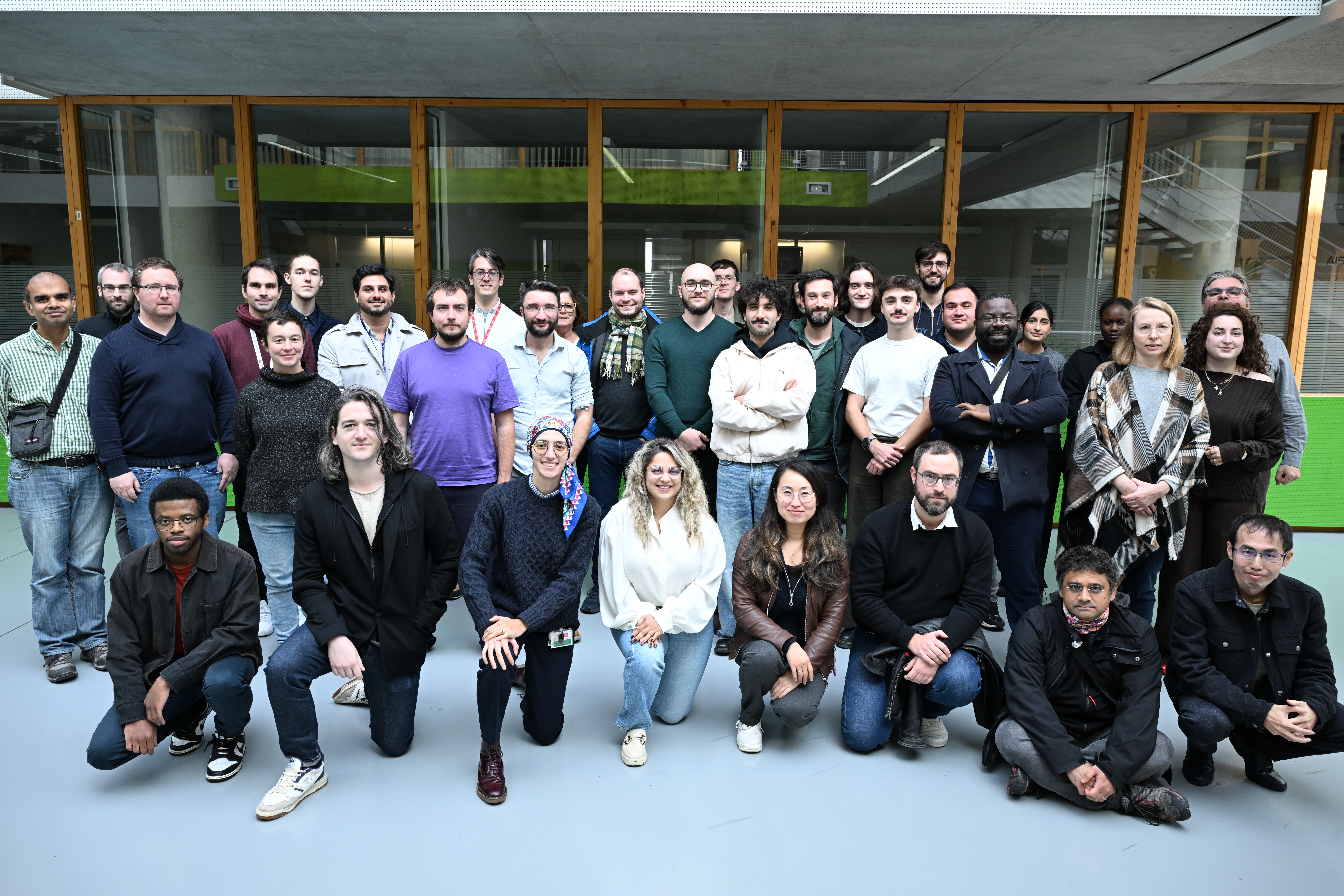
Members

Director

Pascal TREMBLIN (CEA research director)

Executive assistant

Valérie BELLE

Permanent members

Science by Computing Team
  • Team Leader:
    Charles PROUVEUR (CNRS research engineer)
  • Edouard AUDIT (CEA research director)
  • Jean-Michel BATTO (CEA research director)
  • Arturo CONSOLI (UVSQ associate professor)
  • Mathieu LOBET (CEA research scientist)
  • Jean-Bernard MAILLET (CEA research director)
  • Juan Jose SILVA CUEVAS (CNRS research engineer)
  • Riccardo SPEZIA (CNRS senior research scientist)
  • Yves VANDENBROUCK (CEA research director)
  • Yushan WANG (CEA research scientist)
Science of Computing Team
  • Team Leader:
    Julien BIGOT (CEA research scientist)
  • Victor ALESSANDRINI (CNRS research scientist emeritus)
  • Yuuichi ASAHI (CEA research scientist)
  • Simplice DONFACK (CNRS research engineer)
  • Thomas DUFAUD (UVSQ associate professor)
  • Nahid EMAD (UVSQ full professor)
  • Samuel KOKH (CEA research director)
  • Martial MANCIP (CNRS research engineer)
  • Benoît MARTIN (CEA research scientist)
  • Thomas PADIOLEAU (CEA research scientist)
Coordination Team
  • Team Leader:
    Christophe CALVIN (CEA research director)
  • France BOILLOD-CERNEUX (CEA research scientist)
  • Valérie BRENNER (CEA research director)
  • Julien THELOT (CEA permanent staff)
External collaborators
  • Marina LEBOULANGER (Dicio-Conflatio)
  • Jong-Hern MUN (Dicio-Conflatio)

Fixed-term members

Postdocs
  • Yann BEAUJEAULT-TAUDIERE
  • Marc CHUNG TO SANG
Engineers
  • Julian AURIAC
  • Iole BOLOGNESI
  • Thomas BOUVIER
  • Paul GANNAY
  • Sylvain JOUBE
  • Hariprasad KANNAN
  • Benoît MALEZIEUX
  • Jacques MORICE
  • Trévis MORVANY
  • Sage OSBORNE
  • Alwin PHILIPPE
  • Guillaume SALLE
  • Adrien TABERNER
CDD
  • Guigone CAMUS
  • Célia IOULAIN
PhD students
  • Thierry ANTOUN
  • Ester El KHOURY
  • Melissa LARBI
  • Jean-Marc LUDE
  • François-Xavier MORDANT
  • Petro VOLOSHYN
  • Ivan LUCAS
Trainees
  • Zina ASOYAN
  • Fatoumata Sira SIDIBE

Former members